HID Installation Guide for the ST1100
Contributed by:
John Parker
Reseda, California, USA
email to: cpmodem@bigfoot.com
I have had dual HID's on my 93
ST1100 ABS since early Spring of 2000 and on Becci's 94 ABS since early Spring of 2001. I started with the stock
Baja Designs D2R shielded bulbs in my 93 and rode several
thousand miles with them. The problem is one that is inherent with all HID bulbs; they are single element. Therefore,
they do not have hi/low beam capabilities when used in an H-4 headlight. With shielded bulbs in both reflector
housings of the ST, you will have a great low beam but no high beam capabilities. The shielded bulbs will not blind
oncoming drivers if they are adjusted properly, even with them in both headlights. I have tried the following combinations
of HIDs: one D2R shielded HID and one PIAA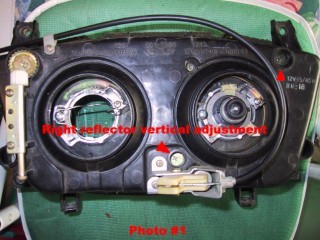 Superbright,
two D2R shielded HID's, one D2S unshielded HID and one PIAA Superbright, one D2R shielded HID and one D2S unshielded
HID, two D2S HID unshielded (my present configuration). Yes there is room under the front fairing on the 93 and
94 ABS bikes for two ballasts and two ignitors (you MUST have a ballast and ignitor for EACH HID). The "two
unshielded HID" configuration MUST be done with a modification to the ST's headlamp switch. Two unshielded
HIDs is way too bright for use around other vehicles. I modified my hi-low beam switch to turn on one HID in the
low beam switch position. I use that to illuminate the right side HID. The Hi beam switch position illuminates
both HIDs. I have adjusted the right side (low beam) reflector to shine at a lower vertical aim level than the
left reflector. This is not necessary with the shielded HID as a low beam, but may be done if it makes you feel
better. There are alignment screws in the ST headlight assembly that accomplish this. The two Philips adjustment
screws on the rear of the headlamp assembly, one just above the dash adjuster mechanism at 8:00 and the other at
the 2:00 position to the right reflector, are the ones to use (see photo #1). They come from the factory with removable
rubber plugs over the holes to seal dirt & moisture from the housing. The screws MUST be turned in the same
direction, the same number of turns to keep the horizontal alignment from changing. Each screw will move the right
reflector in or out in the plane of that screw (ie: when the upper right one is turned cw, the right beam pattern
will move up and to the right at a 45 degree angle to vertical). Conversely, when the lower left one is turned
cw, the beam pattern will move down and to the left at a 45 degree angle. As both of the screws are turned CW the
same amount, the net result is the right beam moving vertically with respect to the left beam. Turning both screws
CCW in the above manner moves the right beam down. The assembly must be removed from the bike to accomplish this
properly (at least the first time you try it). I toyed with the idea of using a stepper motor to adjust the headlight
aim but found the above solution much simpler, more reliable, and less costly.
Superbright,
two D2R shielded HID's, one D2S unshielded HID and one PIAA Superbright, one D2R shielded HID and one D2S unshielded
HID, two D2S HID unshielded (my present configuration). Yes there is room under the front fairing on the 93 and
94 ABS bikes for two ballasts and two ignitors (you MUST have a ballast and ignitor for EACH HID). The "two
unshielded HID" configuration MUST be done with a modification to the ST's headlamp switch. Two unshielded
HIDs is way too bright for use around other vehicles. I modified my hi-low beam switch to turn on one HID in the
low beam switch position. I use that to illuminate the right side HID. The Hi beam switch position illuminates
both HIDs. I have adjusted the right side (low beam) reflector to shine at a lower vertical aim level than the
left reflector. This is not necessary with the shielded HID as a low beam, but may be done if it makes you feel
better. There are alignment screws in the ST headlight assembly that accomplish this. The two Philips adjustment
screws on the rear of the headlamp assembly, one just above the dash adjuster mechanism at 8:00 and the other at
the 2:00 position to the right reflector, are the ones to use (see photo #1). They come from the factory with removable
rubber plugs over the holes to seal dirt & moisture from the housing. The screws MUST be turned in the same
direction, the same number of turns to keep the horizontal alignment from changing. Each screw will move the right
reflector in or out in the plane of that screw (ie: when the upper right one is turned cw, the right beam pattern
will move up and to the right at a 45 degree angle to vertical). Conversely, when the lower left one is turned
cw, the beam pattern will move down and to the left at a 45 degree angle. As both of the screws are turned CW the
same amount, the net result is the right beam moving vertically with respect to the left beam. Turning both screws
CCW in the above manner moves the right beam down. The assembly must be removed from the bike to accomplish this
properly (at least the first time you try it). I toyed with the idea of using a stepper motor to adjust the headlight
aim but found the above solution much simpler, more reliable, and less costly.
There is really no easy way to
make the ST's U.S. DOT headlamp work as a proper low beam. The DOT has messed up the pattern of the low beams so
badly even HIDs cannot make them pattern as well as the European models. However, the HIDs are a far site better
than halogen variants. The biggest problem is that in the left reflector there is an attenuator pop riveted to
the low beam reflector. This results in a pretty crappie low beam pattern on the left side. The right side is not
attenuated and has a very good low beam pattern with an UNshielded or shielded HID. Of course the UN-shielded bulb
works with both high and low beam reflectors simultaneously, so illumination on the right side is from the front
fender to 1/2 mile down the road. Most of us using dual HIDs do it because we are looking for a better high beam.
That is why when dealing with UN-shielded + shielded combos, we are putting the UNshielded bulb in the right side
and using it for high beam only. I believe that if you want a better low beam, you should put the shielded bulb
in the right side and use that for your low beam. You could still run an UNshielded in the left side for high beam
only and get a great improvement over halogen. You would, however, sacrifice mid range illumination. Since writing
the above, I have removed the internal attenuator from the left side low beam reflector. I now have even lighting
from both reflectors with super white stadium-like illumination from the front fender out to 1/2 mile and both
sides of the road for hundreds of feet. This required some major "surgery" on the ST's headlight assembly.
In particular the lens must be removed and the attenuator rivets drilled out. Removal of the lens is a MAJOR undertaking
and is not recommended for the faint of heart, as it is VERY EASY to break the lens during this process. Can you
say $$$$$$$$$ ? If you still want to try this, take a look at my write up: ST headlight attenuator exorcism , but you are totally on your own if you
try this.
Some thoughts on different types of bulbs....The pattern
provided by the OEM 45/45w halogens is the best of any bulb I have tried for evenness of coverage. They just are
not very bright. The next best, and almost as good coverage, is the Philips 60/55w halogen. Again, not very bright.
All of the other available halogens I have tried (I have tried many..ie:Oshram, Candlepower, PIAA..to name just
a few) fall short of those two brands by a large margin in their quality of patterns. I have a desk drawer full of different halogen bulbs ;-} The reason for this variance
can be seen when any of the H-4s I mentioned are held up side-by-side with an OEM bulb. It will immediately become
apparent that the non-OEM bulbs have their filaments at different distances from the base than do the OEM. The
Philips 60/55w are the closest to OEM. This results in beams from those non-OEM bulbs being out of focus with patterns
that do not come close to OEM for quality. It is also why there is such a gap between high and low beam coverage
with non-OEM bulbs.
The dual OEM bulbs create a wide curb to curb pattern, with no hot spots or stray artifacts, that reaches out 40-50
feet ahead (if aimed properly). A single shielded HID in the left housing creates a very wide, very white, very
bright pattern that goes past the curbs by several hundred feet and reaches out 100+ feet ahead (if aimed properly).
Due to the DOT attenuator in the left side, the pattern is very uneven and has many artifacts and hot spots in
it. If the single shielded HID is in the right (non-attenuated) housing the pattern is still past the curbs on
both sides by several hundred feet and reaches out the same 100+ feet, but the pattern is much smoother than the
left side with many less artifacts and hot spots. If using the un-modified (attenuated) headlight, I prefer to
use the right side for my HID high beam because the Un-shielded bulb uses BOTH high and low reflectors simultaneously
to create a super bright, super brilliant white light with a pattern that covers curb to curb and beyond hundreds
of feet and from the front fender to over 1/2 mile ahead and approximately 50 feet high. There are very few artifacts
(and they are out of the field of vision) or hot spots with the unshielded bulb in the right side. With the "exorcised"
headlight assembly I prefer designating right side as the low beam. This will work for both the UN-shielded and
shielded bulbs. By using the right side for the low beam, less of the beam pattern strikes the oncoming drivers,
and more of it illuminates the right side of the road. Of course, the opposite would be ideal for riders in Britannia
and her colonies ;-}
I have used the PIAA Super White Platinums by themselves in dual halogen applications, and also in combination
with a single HID. The PIAA SWPs are the best of the halogens and beat all of the others in brightness, and all
but the OEMs and the Philips 60/55w in pattern. When they are paired with an HID in the right housing, they appear
yellow and dim by comparison. Their only advantage is that they are dual filament so they can use the high beam
reflector in the left housing, where a Shielded HID cannot. The high beam PIAA SWP, however, is totally lost in
the Un-shielded HID light from the right side. On low beam the shielded HID provides a much better illumination
than the PIAA SWP on low beam. Look for dual capsule HIDs in the near future. I have been informed by several HID
manufacturers that HID bulbs will soon be able to provide high and low beams in a single unit. Also ballasts are
becoming smaller and ignitors are being incorporated in the bulb connector.
To summarize, the shielded HID in the left housing is MUCH brighter and has about 2 1/2 times the range of even
the best halogen bulb in the same housing. The only advantage an OEM 45/45w or Philips 60/55w H-4 halogen has over
the shielded HID is in smoothness and uniformity of pattern. However they produce a light so dim that they are
pretty much useless at high speed. The PIAA SWP halogen produces whiter light than those two but still "pale
by comparison" to the HID. The best compromise when using the stock headlight assembly is to install a shielded
HID in the right housing with its un-attenuated low beam reflector, and installing an Un-shielded HID in the left
housing. The pattern on high beam (both lamps illuminated) is full from past both curbs to the sides, and from
the front fender it illuminates the road surface out to over 1/2 mile and 50+ feet up the approaching hillsides
and trees with daylight like white light. The absolute "Ultimate" setup would be a European "E"
headlamp with HIDs installed. I'm still trying to get one of those ;-}
Some have asked about the inherent
"warm-up" time required for HIDs. There is definitely a short delay for the HIDs to come up to full lumens,
but there is plenty of light from the low beam to see with until the high beam is full bright (about 1-2 seconds).
The only place a quicker high beam would be beneficial is when "flashing" other vehicles, for whatever
reason. I just use my 910's for that purpose ;-}
I run an Autocomm Pro 3000 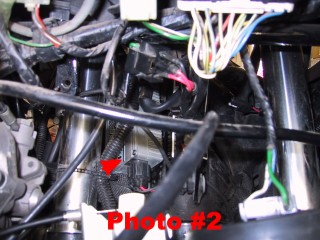 intercom with V-1, Diskman, FRS 2-way radio and cell phone inputs and have
no interference from the HIDs. There is an almost imperceptible change in voltage on my Datel digital voltmeter
when I switch on the two HIDs. Its only 100 watts, after all. Whereas, my Datel shows at .2 volt drop (from 14.4
to 14.2 vdc) when I switch on my PIAA 910's (85w Xtra bulbs....I have done the 40 amp farkel). The ballasts will
mount to either side of the steering head (see red arrow in photo #2). With the unshielded bulbs (equal to over
500 watts of halogen :-) set up the way I have done, I have all of the benefits of the single HID on low beam (but
about twice the brightness on the ground directly in front of me) with the advantage of more and brighter light
out farther and wider in front of me on high beam than the PIAA 910s.
intercom with V-1, Diskman, FRS 2-way radio and cell phone inputs and have
no interference from the HIDs. There is an almost imperceptible change in voltage on my Datel digital voltmeter
when I switch on the two HIDs. Its only 100 watts, after all. Whereas, my Datel shows at .2 volt drop (from 14.4
to 14.2 vdc) when I switch on my PIAA 910's (85w Xtra bulbs....I have done the 40 amp farkel). The ballasts will
mount to either side of the steering head (see red arrow in photo #2). With the unshielded bulbs (equal to over
500 watts of halogen :-) set up the way I have done, I have all of the benefits of the single HID on low beam (but
about twice the brightness on the ground directly in front of me) with the advantage of more and brighter light
out farther and wider in front of me on high beam than the PIAA 910s.
Some folks have asked if the HID
farkel is legal... Technically, anything but the 45/45 watt OEM bulbs are illegal. I go by what I can get away
with. 80 or 100 LEOs have seen them over the past year and a half, and I've not been pulled over. I feel secure
that I am not bothering anyone with them. I am VERY careful to dim them before they illuminate anyone. If a LEO
saw the high beams he would probably forget about the ticket and just impound the bike...or shoot me ;-} These
lights are serious blinders when on high and could very well cause someone to go off the road. I have on rare occasion
fully illuminated a BDC who encroached on my space or failed to dim their high beams. The result is the offending
BDC usually comes to a full stop. Be careful if you mount these lights in their full capacity, as they CAN get
you into a world of shit ;-] I have Cepek 230 watt bulbs in my roof lights on my Landcruiser and 130 watt bulbs
in the C-1000 lights on the brush guard. The HIDs are right up there with those lights in eye blinding dazzle effect
on other drivers. Not something to be careless or playful with....
The only difficult problem I had
with the HID setup was initially focusing the bulbs inside the ST's headlight housing. I was the original prototype
tester on the ST, so BD had no idea how thick a spacer to use for proper focus on the ST. After many, many hours
(nights) of trial and error, I achieved the proper thickness spacer for correct focus in the ST. The new "kits"
BD is marketing have the proper spacer included. The new kits work best if you epoxy the BD H-4 and STA (Sport
Touring Accessories)
Honda adapter rings to the HID bulb base. This keeps everything together and allows the 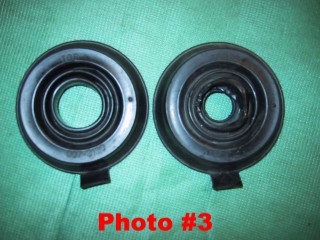 bulb to be positioned into the headlight housing
more accurately. I have found that it is very easy to NOT get the bulb and its adapter rings FULLY seated into
the notches in the headlight housing. If not FULLY seated, the resulting beam pattern will be out of focus. I found
that a mis-alignment of as little as .125" was enough to throw the focus out. The most critical is the alignment
of the bulbs in the HORIZONTAL plane. That is... all three of the adapter tangs must be fully into their respective
notches in the headlight housing. The hold in spring clip must be severely re-bent to cause it to hold the HID
bulb and its adapter rings securely in place. The bulb must NOT be able to be rocked with your finger when secured
properly. The rubber dust seal must be modified by enlarging the center hole so that it will fit tightly to the
larger diameter HID socket. (See Photo #3) The resulting pattern, when shined on a vertical surface, is a very
clearly defined wide arc pattern with sharp cutoffs at the top and the bottom.
bulb to be positioned into the headlight housing
more accurately. I have found that it is very easy to NOT get the bulb and its adapter rings FULLY seated into
the notches in the headlight housing. If not FULLY seated, the resulting beam pattern will be out of focus. I found
that a mis-alignment of as little as .125" was enough to throw the focus out. The most critical is the alignment
of the bulbs in the HORIZONTAL plane. That is... all three of the adapter tangs must be fully into their respective
notches in the headlight housing. The hold in spring clip must be severely re-bent to cause it to hold the HID
bulb and its adapter rings securely in place. The bulb must NOT be able to be rocked with your finger when secured
properly. The rubber dust seal must be modified by enlarging the center hole so that it will fit tightly to the
larger diameter HID socket. (See Photo #3) The resulting pattern, when shined on a vertical surface, is a very
clearly defined wide arc pattern with sharp cutoffs at the top and the bottom.
My final adjustment of the dash
mounted adjustment knob was 2 full turns CW from when the beam first starts to move up (after taking up the slack).
This provides a high beam pattern that covers from the front fender out to approximately 1/2 mile at 50' high on
trees or hillsides on the outside of approaching turns and approximately 120 degrees wide for illumination of the
dark sides of the road where "Bambi" waits to leap out in front of unsuspecting STers. The low beam pattern
covers from the front fender out to 100 - 120 feet an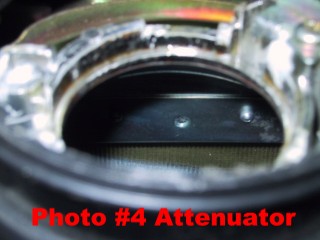 d
d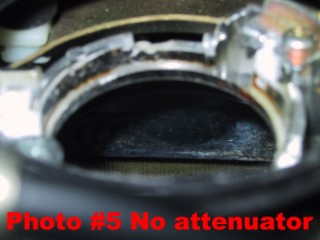 the same 120 degrees of beam width. When
on low beam, I don't get any "flashers" from oncoming drivers.
the same 120 degrees of beam width. When
on low beam, I don't get any "flashers" from oncoming drivers.
As I briefly mentioned above,
one reason that you can "get away with" an un-shielded HID in the left housing for low beam (if that
is your choice) is that the left side has a dull metal plate riveted to the low beam reflector (top). This DOT
(Department Of Transportation) mandated "attenuator" reduces the low beam light from the left side considerably.
The two photos to the left (looking through the bulb openings) show the attenuator in the left side and the non
attenuated reflector in the right side (See Photos #4 & #5). With my modified headlight assembly with two UN-shielded
HIDs installed, and using the right reflector for low beam, the forward illumination does not hit the oncoming
drivers eyes. There are some circumstances when a vehicle to my right will be briefly spotlighted with HID light,
but that hasn't been a problem yet. It has probably kept some BDCs from pulling out from side streets or changing
lanes into me from the right.
Once I set my dash adjuster, I
don't have to fiddle with it again unless I add or subtract to the payload substantially. Once in a while, when
I am running on low beam(one light lit), another m/c rider will signal me that one of my headlamps is out, but
he/she quickly retracts that when I hit the hi beams ;-} I have had no more problems with people flashing their
lights at me than I did with the halogen PIAA Superbright 60/55's in the ST headlamp. I have approached head-on,
and driven behind highway patrol and local PD in all of the western states and three countries since installing
them, and I have not once been stopped by a LEO for headlights.
...John
DISCLAIMER: All observations made in this tome are mine
and based solely on my own anecdotal experiences. YMMV, of course. You are "on your own", and I take
no responsibility if someone tries this farkel with the unshielded (or shielded ;-) bulbs and gets into trouble
with the law, damages their person or property, or goes blind.